Blended learning model
The blended learning model is said to be
one of the most effective and efficient way of learning. As the name itself
suggests, this model combines online studying method along with the physical
presence of teacher. Didn’t get it yet? Well, to elaborate it a little more, we
can say that it pertains to teaching that blends, online learning like through
webinars, video streaming, audio-visuals, virtual classroom and every possible
source of digital media with teacher who would be present physically that is brick
mortar style learning.
Source of image -- http://www.trinityweblog.org/worldlanguages/files/2014/05/chart-blended-1bg2yrw.jpeg

Basically, it is a model whose origin is
yet cannot be traced but still one can say that it was roughly in 1990s however
today what this model means to us is a combination of face to face learning
method along with resourceful and appropriate usage of technology. We all know
that the conventional model of teaching lacked the ability of channeling a
student’s imagination and somehow it bounded the creativity of student since the
only person they were dependent upon is their teacher. While on the other hand
going solely on technological method, the lack of presence of teacher can also
lead to misinterpretation forming unreliable notions. Thus, the blended model
stands to be apt because, it neither bonds one’s creativity nor it keep the
student away from the interaction and also allows the progress to occur at its
own pace.
Video source -- https://www.youtube.com/watch?v=QF8ODHN6Os8
Furthermore, the blended model of learning
is categorized into six different models namely – Face to face model, Rotation
model, flex model, lab model, self blend model and online learning model. These
models though fall under blended learning method however; their procedure and
impacts are different from one another. It is totally up to you, to decide
which model is the finest for your subject and suits it perfectly.
https://blogger.googleusercontent.com/img/b/R29vZ2xl/AVvXsEi0NnrCrR6VX0-vNxF9q3hrOyU6SCHg4KbJKo7LELFSVoPFUkOmWCElJ5krw64yrC2pSN0u7kJIjD-F7oWK6MMenGCllRUUwMop0Xe-Cr6Nr0VMm9RCci8S5493uSlN_VclnlZJ2B149t0/s1600/Tech+Integration+vs+Blended+Learning.png

- Face
to face model – The face to face model of blended learning is similar
to the traditional model. The only difference is that online classes are
also provided to complement this learning process. In this model some
selected students are given to try their hands on technological based
learning. This could be a bunch of students who are slow at learning so
that they can refer to more classes than average students and cover up at
their own pace whereas it could also be given to the students who score
above the average grades to help them in having a better understanding and
outlook towards the subject.

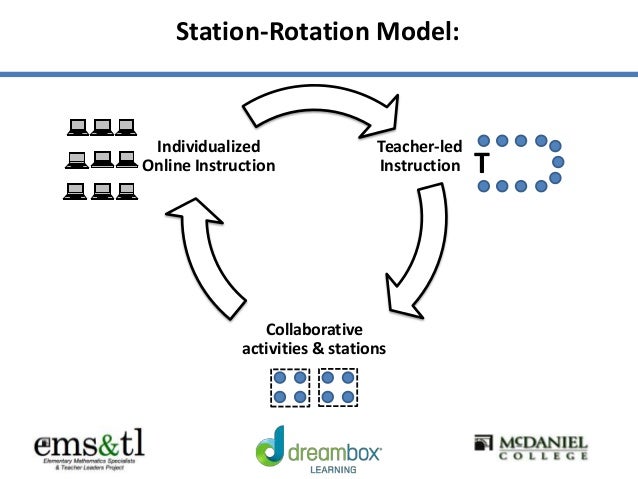
- Rotation
Model – Now, this isn’t that tough to understand. As the name
suggests, the student or the learner is exposed to both the models of
learning that is conventional and technological on a fix schedule. This
implies that, suppose a teacher is taking up mathematics class then,
Monday to Thursday would be the day of teaching through conventional
method that is the brick and mortar on Friday the teacher would let the
kid discuss what he or she has learnt with his friends and then on
Saturday he would be exposed to technology, computer in this case and
practice what he has learnt. This schedule will further get repeated at a
similar phase. This is rotation model for you.

Image source -- http://image.slidesharecdn.com/02-27-13edwebwebinarjeffpiontektimhudson-130821153220-phpapp02/95/principals-guide-to-blended-learning-for-elementary-mathematics-18-638.jpg?cb=1377117218
- Flex
model – Let us move one to yet another category of blended learning.
This is named as, the flex model. The core idea prevails in this model is
the ‘flexibility’. Now how is this model different from the previous one?
We believe that comparison with one another can provide you a better
understanding of the model. So, unlike in rotation model, student is not
compulsion to follow a particular schedule rather a level of ‘flexibility’
is provided which enables the student to take up their own source of
learning, at their own pace. It lets them go as fast as they can and as
far as they can. For instance, in a school there will be a cafeteria, a
place where student can discuss, a lab for computers and a conventional
classroom. In this model there is no hard and fast rule that a particular
schedule has to be followed. Any student can learn online discuss it with
student and attend class or do the other way round. We hope that we are
pretty much clear with it now.

- Labs
model – The labs model of blended learning mainly focuses on
e-learning. A student or school opts for this model to in an answer to
resource constraint problems. In this model a student takes the learning
lessons only online to a dedicated centre of computer. These centers do
have adults to supervise students while they work on their course work in
their respective centers of learning. This model allows students to take
up courses that has issues of teacher constrains but are provided by
school online willingly, letting a student learn it at his or her own
comfort level and speed.

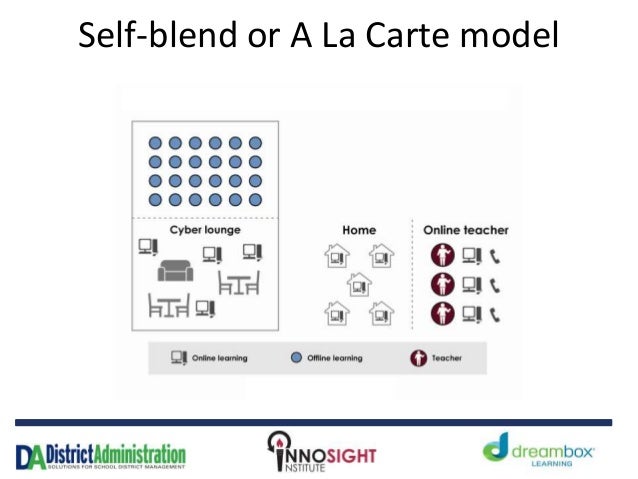
- Self Blend model – The self blend model
is more popular in high school and requires student who are highly driven
by the desire of learning more and beyond the classroom. Now, let us tell
you how do this model functions. In this model students are free to choose
the online course that they wish to learn, meaning they can opt for
something more than just traditional classroom. If they desire to take up
an advanced course in any particular subject of their choice then they are
free to do so.
http://image.slidesharecdn.com/03-28-13da-webinarmichaelhorn-130822182054-phpapp02/95/blended-learning-today-and-tomorrow-17-638.jpg?cb=1377213753
- Online driver model of blended learning –
To put it in a simple fashion we would say that the online model of
blended learning is opposite to that of face to face. In this form of
blended learning the classes and interactions are taken online instead of
traditional ones. However, face to face check-ins is optional though the
study material is delivered directly online. This model is gaining
popularity among students who prefer learning courses independently and at
their own flexible schedule.
http://edcetera.rafter.com/wp-content/uploads/2013/03/blended-learning-found-to-be-most-effective-11012601.jpg


No comments:
Post a Comment